Judgments, legislation, regulators’ decisions, the Commons committee report and the 2025/26 accounts were checked on 30 October 2026. Creditors approved the structure for a larger rescue facility on 30 October, but the extra money is not yet committed. Sections marked as our analysis are commentary, not findings. No individual named here has been convicted of any offence connected with these events, and no person or company named here has been convicted of fraud over the group’s finances. We welcome scrutiny, including from the National Audit Office. This is research, not legal or financial advice.
The story in plain English
Start here. You do not need to know what a bond is. This section tells the story from first principles, and every number in it can be checked against the sources listed and the fuller record further down the page.
Plain English
A hot day at the river
Picture a hot day in summer. You want to take the children to the water. In much of England that means the seaside. Thames Water’s story is mostly about rivers and streams, so here it means the riverbank.
[1] bathing waters its discharges could affectOxford has one official bathing site, Wolvercote Mill Stream. Its 2025 rating was Poor, the lowest grade. Oxford City Council says the official status means the water is monitored, not that it is safe, and that anyone who swims does so at their own risk. Wallingford Beach, on the Thames, was rated Sufficient. Thames Water lists both among the bathing waters its discharges could affect. The ratings do not say how much of the pollution came from Thames Water, and the company says farming and road run-off also affect river health.
[2] Wolvercote Mill Stream and Wallingford Beach · [3] bathing water sites · [1] bathing waters its discharges could affect · [4] company responseNobody seems to count the days out that were spoiled. We found no official figure for how many people stayed out of the water or fell ill. The nearest thing is a charity’s tally: by August 2026 Surfers Against Sewage had received 765 sickness reports from 406 places in 2026. Those reports come from the whole UK, not just Thames Water’s area, and they are people’s own accounts, not medical findings.
[5] Surfers Against Sewage figuresThe best-known case came before the 2024 Boat Race, when crews were warned not to enter the Thames because of E. coli. Oxford later confirmed that three of its crew had fallen ill that week, but did not directly blame the river. Proving that one discharge made one person ill is hard, and we found no court or regulator finding that does so.
[6] Boat Race reportPlain English
The safest business you can imagine
Now think about the business behind that river. Everyone needs water. That is the assumption this story rests on: a home cannot function normally without it, so people cannot simply stop buying. Nobody can move to a different network. A regulator sets the price every five years. Thames Water’s group serves 24% of the UK population. In our view, few businesses anywhere have customers this certain.
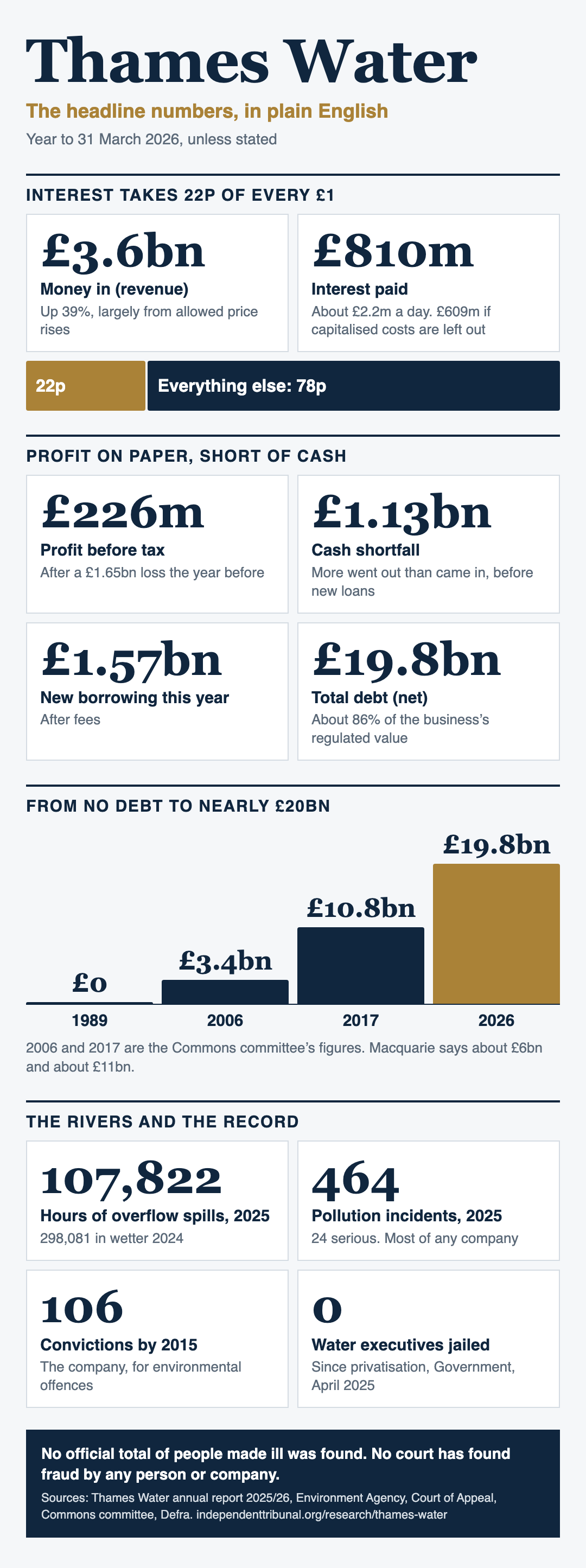
[7] paras 2, 10 and regulatory frameworkIt also began with a clean sheet. Evidence recorded by the High Court as unchallenged says the business went into private hands debt-free in 1989. By March 2026 it owed about £19.8bn.
[7] para 60 · [8] gearing and interest coverPlain English
How a safe business ends up owing £20bn
The logic is simple. Lenders like a business whose customers cannot leave, so they lend to it. Debt is usually cheaper than shareholders’ money. Ofwat set prices assuming a certain level of debt, so a company that borrowed more than that could keep the difference as profit. The Independent Water Commission described this incentive and said Ofwat did not, or could not, intervene.
[9] para 410Borrowing is not wrong in itself. Pipes and treatment works last for generations, and a family borrows to buy a home for the same reason. Macquarie says over £11bn was invested during its years as an owner, and that the regulated asset base doubled.
[10] sections on investmentThe trouble comes when money leaves at the top while debt grows underneath. The Commons committee says that between 2006 and 2017 debt rose from £3.4bn to £10.8bn while an estimated £2.5bn was paid in dividends. Macquarie disputes those figures and puts distributions at about £1.1bn, with debt going from about £6bn to about £11bn. Money has no label, so nobody can say that one borrowed pound paid for one dividend. The common-sense point still holds: a pound paid to owners is not spent on a pipe, and a pound borrowed has to be paid back with interest.
[11] para 4 · [10] sections on distributions and debtA monopoly cannot run out of customers. It can run out of money to pay its lenders. In March 2024 the shareholders called the business plan “unfinanceable and uninvestible” and declined to provide £750m. From April 2024 the parent group stopped servicing its debt and defaulted.
[7] para 63Plain English
The words that trip everyone up
Financial words in plain English, with Thames Water’s 2025/26 figure| Word | What it means | Thames Water |
|---|
| Revenue | The income from customers’ bills that the company counts as earned in the year. It is not the same as cash collected, since some bills go unpaid, and nothing has been taken off yet | £3.6bn |
|---|
| Profit | What is left on paper after all costs, including interest | £226m before tax |
|---|
| Cash flow | The money that actually came in and went out. It can be negative even when there is a profit | £1.13bn short, before new loans |
|---|
| Interest | The price of borrowing. It pays for the loan and does not reduce the debt | £809.6m paid |
|---|
| Gross interest | All the interest paid, before taking off any interest received. Plain “interest paid” usually means this | £809.6m |
|---|
| Net interest | Interest paid minus interest received | £494m |
|---|
| Capitalised interest | Interest counted as part of the cost of building something, so it does not show up as a running cost that year. It is still real | £200.8m |
|---|
| Net debt | What is owed, minus the cash held | £19.8bn on the lenders’ measure, £18.5bn in the accounts |
|---|
| Gearing | Debt as a share of what the business is worth, like owing £86 on a £100 house | About 86% |
|---|
If you mix up revenue, profit and cash, you are in good company. They are three different things, and this story depends on the difference.
[12] financial review; note on movements in net debt · [13] financial highlights · [8] gearing and interest coverPlain English
What the debt costs, in pennies
Every £1 of underlying revenue, 2025/26 (pence are our arithmetic)| Measure | Pence in the £1 | Amount |
|---|
| Underlying revenue | 100p | £3,615.6m |
|---|
| Interest paid, including capitalised costs | 22p | £809.6m |
|---|
| Interest in the cash flow statement | 17p | £609.3m |
|---|
| Net interest paid, after interest received | 14p | £494m |
|---|
| Share of bills servicing debts (committee’s estimate) | 27p | Not given as an amount |
|---|
These are the numbers that matter most. In the year to March 2026 the company’s underlying revenue was about £3.6bn. In the same year it paid £809.6m of interest on its borrowings. That is about 22p of every £1 coming in, or about £2.2m every day, and none of it pays off the debt itself.
[12] note on movements in net debt; income statement · [13] financial highlightsThe other figures are real too, and they measure different things. £200.8m of that interest was capitalised, which means it was counted as part of the cost of building projects. Leave that out and the figure is £609.3m, about 17p. Take off £114.9m of interest received and it is £494m, about 14p. The Commons committee estimates that 27% of bills go towards servicing debts and says that is similar to the sector average, so heavy debt costs are not unique to Thames Water.
[12] note on movements in net debt · [11] para 12Scale the 2025/26 numbers down to a household, and a family bringing in £36,156 a year would pay £8,096 in interest and owe about £198,000, more than five times its income. That family would also have spent about £11,300 more than it took in, before new borrowing. In fairness, part of that went on rebuilding the house: capital investment was £2,680m, and the regulator’s measure of the business’s value is £22.7bn. But the debt is about 86% of that value, the highest in the sector according to the committee, and this family cannot sell up and move.
[13] financial highlights · [8] gearing and interest cover · [11] para 12Customers were paying more all the while. Underlying revenue rose 39% in 2025/26, largely from allowed tariff increases.
[13] financial highlightsPlain English
Does it make a loss?
Money in and money out, year to 31 March 2026, in order| Step | Amount |
|---|
| Money billed (underlying revenue) | £3,616m |
|---|
| Operating profit, after running costs and wear on assets (underlying) | £1,282m |
|---|
| Reported profit before tax, after finance costs and one-off items | £226m |
|---|
| The same line a year earlier | £1,647m loss |
|---|
| Cash from running the business | £1,909m in |
|---|
| Cash spent on investment | £2,544m out |
|---|
| Net interest paid | £494m out |
|---|
| Cash shortfall before new borrowing | £1,129m |
|---|
| New borrowing, after fees | £1,570m in |
|---|
| Net debt in the accounts, start to end of the year | £16,794m to £18,516m |
|---|
On paper, not last year. After costs, interest and other finance items, the company reported a profit before tax of £226m for 2025/26. The year before it reported a loss of £1.65bn, mostly because of a £1.27bn write-down of a loan to another group company. The swing back came with a 39% rise in revenue, largely from allowed tariff increases.
[12] income statement · [13] financial highlightsIn cash, yes. Running the business brought in £1,909m, investment took out £2,544m, and net interest took out £494m. That left it £1,129m short, so lenders put in another £1,570m after fees, while only about £11m of borrowings and leases was repaid, because the rescue plan pushed repayments back. No dividends went to outside shareholders.
[12] summary cash flow statementProfit and cash differ for an ordinary reason: a new sewage works is paid for in cash when it is built, but charged against profit a slice at a time over many years. So reporting a profit while needing loans to keep going is not a contradiction. It is the position Thames Water is in. The company itself says recapitalisation is not certain.
[12] financial review · [14] announcementPlain English
What happened to the rivers
Start with how a sewer works. When it rains hard, sewers fill up. Storm overflows are a relief valve: they release sewage diluted with rainwater into rivers so that it does not back up into homes and streets. That is what they are permitted for. Using them at other times is a breach.
[15] section on storm overflowsThe Environment Agency’s monitors recorded Thames Water’s overflows spilling for 298,081 hours in 2024 and 107,822 hours in 2025. Laid end to end, that is about 34 years and about 12 years of continuous spilling, each packed into one calendar year. These hours are time, not volume, and many overflows run at once. The average spill lasted 11.7 hours in 2025, the longest of any company in the return. The fall from 2024 is real, but the Agency says much of the improvement across England reflects unusually dry weather. Thames Water also credits the Thames Tideway Tunnel. Several other companies recorded more hours in total.
[16] tables 1 and 2, our arithmetic · [17] announcement · [12] sewage and storm overflow reviewRain does not explain it all. Ofwat found that 157 wastewater works, 66% of those with the relevant permit conditions, could not meet those conditions. In 2025 Thames Water had the most pollution incidents of any company, 464, including 24 serious ones.
[18] notes for editors · [15] star ratings and serious pollution incidentsPollution harms living things. Between 2012 and 2014 at least 1.4bn litres of untreated sewage reached the Thames and its tributaries, enough to fill about 560 Olympic swimming pools. Reporting of the case said people and animals were left ill and thousands of fish died. Judge Sheridan called it “a shocking and disgraceful state of affairs”. One crayfish fisherman lost £25,000 in a year. At Henley in 2016, a spill killed 1,144 fish and other water life across 13 species, and the stream took almost a year to recover. Near Gatwick, investigators found almost 1,400 dead fish, a fraction of the number the Agency believes were killed.
[19] report of the sentence · [20] summary of harm · [21] announcement · [22] report of the sentenceSome of these places are rare. Chalk streams are among the rarest freshwater habitats on Earth, and around 85% of the world’s 280 are in England. The Telegraph reported in January 2025 that an overflow at Markyate had been discharging into the River Ver for more than 1,000 hours. Thames Water said its sewers had been overwhelmed after one of the wettest years in its region and pointed to plans to upgrade 250 sites, including Markyate.
[23] introduction · [4] report and company responseFurther downstream, the tidal Thames shows what investment can do. Parts of it were declared biologically dead in 1957. The Zoological Society of London’s January 2026 health check found seals, seahorses, eels and even sharks, and credited upgraded sewage works and the Lee Tunnel for long-term improvements in water quality. The £4.6bn Tideway Tunnel was fully connected in 2025. The same report warns that sewage effluent continues to raise nitrate levels, which can harm aquatic life, and that the number of fish species has slightly declined, for reasons not yet known.
[24] summary of findingsPlain English
Who was supposed to stop it?
None of this was secret. The dividends were in filed accounts, the debt was in published reports, and the regulators’ rules were public. So the useful question is not how nobody noticed. It is why nobody stopped it.
[7] para 60, drawing on filed accounts · [9] para 410Different bodies had different jobs. Ofwat regulated the money and the service, the Environment Agency the rivers, the Drinking Water Inspectorate the tap water, and Defra set the policy. In April 2025 the National Audit Office reported on all of them under the headline “Regulators have failed to deliver a trusted and resilient water sector”. It found that no regulator was responsible for proactively inspecting wastewater assets. In December 2024 the Office for Environmental Protection had found that Defra, the Environment Agency and Ofwat failed to comply with environmental law over storm overflows.
[25] press release · [26] findingsThe company has been punished many times: convicted on 106 occasions by 2015, with more fines since, and £122.7m in Ofwat penalties. Those convictions belong to the company. As the Government said in April 2025, no prison sentence had been handed to a water executive since privatisation. The section on why nobody is in prison explains the reasons, including how the law was written.
[27] para 44 · [18] announcement · [28] announcementPlain English
The other side of the story
A fair account has to include what goes right. The National Audit Office says the UK has one of the highest standards of drinking water in the world, and compliance with drinking water standards in England was 99.97% in 2024. That figure covers all of England, not Thames Water alone. The company’s own water quality index worsened from 2.04 to 4.32 in 2025, where lower is better. It says one positive test at a large works caused over half of that score, and that none of the failures was a risk to public health.
[25] press release · [29] overall compliance table · [12] water qualityNot every owner came out ahead. The pension and sovereign wealth funds that took over from 2017 received no dividends and wrote off their investment. The company invested £2,680m in 2025/26, and says that in an average year it treats 99.46% of the wastewater entering its system.
[11] paras 5, 12 · [13] financial highlights · [12] sewage and storm overflow reviewThree more limits matter. The High Court said it was not its job to attribute blame. No person or company named here has been convicted of fraud over the group’s finances. And whether customers will end up paying for the rescue is still disputed and not yet known.
[7] paras 61, 303–304 · [30] statements of each sidePlain English
The whole story on one page
Thames Water from privatisation to 30 October 2026| When | What happened |
|---|
| 1989 | Moved into private hands debt-free, on evidence the High Court recorded as unchallenged |
|---|
| 2006 | Macquarie’s period as an owner begins. Debt is £3.4bn on the committee’s figure, about £6bn on Macquarie’s |
|---|
| 2015 | The Court of Appeal records 106 convictions covering 162 environmental offences since 1991 |
|---|
| 2017 | Macquarie’s period ends, with debt at £10.8bn on the committee’s figure and about £11bn on Macquarie’s. A record fine of over £20m follows six pollution incidents. No outside shareholder receives a dividend from now on |
|---|
| 2024 | In March shareholders decline to provide £750m. In April the parent group defaults. In December the environmental watchdog finds that the regulators failed to comply with environmental law |
|---|
| 2025 | In February the High Court sanctions the rescue plan in 178 pages. In April the Court of Appeal dismisses the appeals, the National Audit Office reports, and the Government confirms no water executive has been jailed. In May Ofwat’s penalties reach £122.7m |
|---|
| March 2026 | Debt of £19.8bn and gearing of 86%, on revenue of £3.6bn |
|---|
| September 2026 | The Commons committee says “Thames Water is at the end of the road” |
|---|
| October 2026 | S&P cuts the company to CCC−. Creditors approve the structure for a larger rescue, but the extra £2.4bn is not yet committed |
|---|
Strip away the jargon and three plain questions remain. How did a business with guaranteed customers and no debt in 1989 end up here? Who benefited? And who pays? The rest of this page sets out the record on each, including where the record runs out.
[7] para 60 · [11] paras 4–5, 14, 28–29 · [27] para 44 · [26] findings · [25] press release · [28] announcement · [18] announcement · [20] summary of the sentence · [10] sections on acquisition and debt · [31] outcome · [8] gearing and interest cover · [32] announcement · [33] reportThe most boring business in Britain
Water is the dull end of capitalism. Everybody needs it, nobody can shop around, and a regulator sets the price. That is exactly why it can carry so much debt. This is how the structure works, using the court’s own description of it.
Background
A captive customer base
The Thames Water group is the largest water and sewerage provider in the UK by customers, serving 24% of the population. It runs over 32,000 km of water mains and 109,000 km of sewers, about 354 wastewater and treatment sites and 88 water treatment works, and employs about 8,000 people.
[7] paras 2, 10Every five years Ofwat sets allowable price increases and performance targets. Each company has a monopoly in its area, so a customer cannot move to another network. In our view that makes for an unusually predictable income, which is what lenders want to see.
[7] regulatory framework, from para 36 · [34] factsCourt record
From zero to about £20bn
Charlie Maynard MP gave evidence to the High Court, which the judge recorded as unchallenged, that the operating company and its group were transferred to the private sector debt-free in 1989. By 28 November 2024 principal debt was about £19bn, plus hedging with a further £1.68bn mark-to-market liability, against underlying annual earnings before interest, tax, depreciation and amortisation of £1.2bn.
[7] para 60, quoting Maynard 1 at paras 24–25The same evidence cited a Macquarie note putting debt at 6.5 times those earnings when the business was sold by RWE, rising to 10 times in 2017. Macquarie’s own account is in the section on the Macquarie years. Covenant net debt had reached £19.8bn by 31 March 2026.
[7] para 60 · [10] section on debt levels · [8] gearing and interest coverOfficial review
Why more debt pays
The Independent Water Commission explained the incentive plainly. Ofwat sets the allowed return using a notional level of gearing. Debt is usually cheaper than equity, so a company may be incentivised to borrow more than the notional level and keep the difference between the allowed return and its true cost of capital as profit.
[9] para 410The Commission added that Ofwat did not, or could not, intervene to address this. It also recorded that Ofwat itself has said that, on balance, debt structures such as whole business securitisation have not been beneficial for companies, while some companies and investors said they can benefit customers through cheaper financing.
[9] paras 410, 681Professor Sir Dieter Helm, quoted in unchallenged evidence before the court, wrote that Thames used its balance sheet “to mortgage the assets and pay out the proceeds in special dividends and other benefits to the shareholders”. He traced this to the mid-1990s, “when OFWAT … decided not to act to protect the balance sheets. It was as if the owners were shown an open goal – not only had the goalkeeper been removed, but the referee was taken off the pitch too.” In plain English: nothing in the company’s structure stopped the borrowing, and the regulator chose not to police it. That is his opinion, recorded as evidence. The judge said it was not for the court to attribute blame.
[7] para 60, quoting Maynard 1 at para 27 · [7] para 61Company accounts and disclosures
The offshore companies
Helm also wrote of “an offshore set of companies … going under the label of various Kemble entities”. The record is more specific. The Kemble companies were set up in 2006 to buy Thames and hold it for its investors; Thames Water describes its Kemble financing companies as UK-incorporated.
[7] para 60, quoting Maynard 1 at para 27 · [35] other companiesThe offshore part was two Cayman Islands financing subsidiaries, Thames Water Utilities Cayman Finance Ltd and Thames Water Utilities Cayman Finance Holdings Ltd, which raised bond debt for the group. Thames said they were “fully registered in the UK for tax”, but that “their existence confused perceptions”. It moved their debt to a UK company, Thames Water Utilities Finance plc, on 31 August 2018, and they were dissolved on 28 February 2019. Liquidation fees were £5.9m.
[36] governance review; financial statements note 32; finance expenseOur reading: offshore is not the same as dodging tax, and by the company’s account these entities were taxed as UK companies. They concerned where the debt was issued, not where the profit was taxed. What drove the debt was the incentive described above, not the address of the companies that issued it.
[36] governance review · [9] gearing and incentivesCourt record
The Russian doll
Simplified group chain at the time of the 2025 proceedings. This is not a full Companies House ownership tree.| Company | What it does |
|---|
| Kemble Water Holdings Ltd | Ultimate parent. Kemble group companies stopped servicing their own debt from April 2024 |
|---|
| Thames Water Ltd (TWL) | Direct parent of the plan company and also its subordinated creditor. It voted against the plan and opposed it in court |
|---|
| Thames Water Utilities Holdings Ltd | The plan company. Holds the shares and gives guarantees. No employees and no material assets other than shares in its subsidiary |
|---|
| Thames Water Utilities Ltd (TWUL) | The regulated company that actually supplies water and sewerage |
|---|
| Thames Water Utilities Finance plc (TWUF) | Finance subsidiary. With TWUL, it issues or borrows much of the group’s debt |
|---|
A group like this has several companies for reasons that are not in themselves improper: separating the licence, the borrowing, the guarantees and the ranking of creditors. The surprising detail is at the top. In the 2025 case, the plan company’s own parent opposed its subsidiary’s rescue, as a creditor.
[7] paras 5, 7, 9–10Court record
Who gets paid first
Broad creditor ranking as at late 2024, with the rescue funding added by the 2025 plan. Actual priority depends on contract terms and on what triggers payment| Rank | Layer | Size | How it voted on the 2025 plan |
|---|
| Added 2025 | Super senior funding | £1.5bn, with capacity for £1.5bn more | Created by the plan, with priority over existing debt |
|---|
| 1 | Liquidity facilities | Undrawn safety net | Not broken out in this summary |
|---|
| 2 | Hedging agreements | A £1.68bn mark-to-market liability in November 2024 | Payments continue in the ordinary course |
|---|
| 3 | Class A debt | About £16bn across 53 instruments | Almost all in favour |
|---|
| 4 | Class B debt | About £1bn across 12 instruments | Only 15.5% of those voting approved |
|---|
| 5 | Subordinated debt | A £4.25bn loan, with £1.98bn of principal and £1.25bn of unpaid interest outstanding, plus four loans totalling £331m | Against. The sole creditor in this class was TWL, the parent |
|---|
The group uses a whole business securitisation, meaning debt secured against all or substantially all of its assets. The debt sits in about 60 instruments. Lenders hold fixed charges over the shares, the land, the bank balances, the book debts and more, plus a floating charge over the whole undertaking of each group company.
[7] paras 11–12, 21The list below is the judge’s broad summary. He said the exact order is much more complex.
[7] para 19Follow the money
Three questions get mixed up all the time. How much was paid out, who actually received it, and was the borrowing used to pay for it. The record answers the first much better than the other two.
Court record
What the court was told about dividends
Operating-company dividends in evidence before the High Court, not adjusted for inflation| Period | Dividends |
|---|
| 1990–1999 | £2.061bn |
|---|
| 2000–2009 | £1.769bn |
|---|
| 2010–2019 | £1.823bn |
|---|
| 2020–2024 | Over £300m |
|---|
| Total (our arithmetic) | About £5.95bn |
|---|
Mr Maynard’s unchallenged evidence set out dividends from the operating company, taken from its filed annual statements. Added together they come to about £5.95bn. That total is our arithmetic. The figures are not adjusted for inflation.
[7] para 60, quoting Maynard 1 at para 23Dividends from the operating company are not the same as cash reaching outside investors. The evidence was that most of the money paid up to the plan company went further up the structure, either to equity investors or to service debt.
[7] para 60, quoting Maynard 1 at para 23The campaign group We Own It gives bigger numbers: £10.4bn in dividends since privatisation on its website, and £11.9bn “extracted” in a statement to The Guardian. We could not reproduce either figure from the sources we checked, and the second uses a wider word than dividends. We attribute them to the group and do not adopt them.
[37] headline figures · [30] We Own It statementFour things should not be added together: dividends from the operating company, money reaching outside equity investors, debt service at holding-company level, and other related-party transfers. These figures measure only the first. Tracing the rest needs the filed accounts of every company in the chain, which we have not done.
[7] para 60Parliamentary finding
The Macquarie years, 2006 to 2017
The Commons committee reports that during Macquarie’s stewardship debt rose from £3.4bn to £10.8bn, while an estimated £2.5bn was paid in dividends to shareholders. It says much of the blame has been attributed to Macquarie.
[11] para 4The committee also cites analysis for the BBC, which concluded returns averaged 15.5% to 19% a year, and found that £2bn of new debt appeared to have been transferred from Macquarie to Thames Water, seemingly in contravention of licence conditions. That is the committee’s report of a media analysis, hedged in its own words. No court or regulator finding on that point appears in the material we checked.
[11] para 4Macquarie disputes the picture. It says its funds owned about 48% for much of the period and sold down gradually, that annual gross returns were 12% to 13%, that over £11bn was invested, that the regulated asset base doubled from about £6.5bn to about £12.9bn, and that debt went from about £6bn to about £11bn. It says the regulated company stayed investment grade throughout, and that debt stayed at 6 to 7 times earnings until the last regulatory period, when it reached about 10 times because of tighter regulatory returns.
[10] sections on returns, investment and debtOn distributions Macquarie gives a much lower figure: about £1.1bn in total, made up of £879m in dividends and £277m of interest on shareholder loans, of which £508m went to investors in its funds. It calls a £2.7bn figure in circulation a misrepresentation that adds inter-company movements. It says more expensive holding company debt was exchanged for cheaper operating company loans after consulting the regulator, auditors and rating agencies, and that the company met all its regulated licence conditions throughout. The sources we checked do not reconcile these figures with the committee’s.
[10] sections on distributions and licence conditionsThe two debt figures have different starting points, £3.4bn and about £6bn. Macquarie’s figure comes from its description of about £6.2bn of third-party debt at acquisition. The sources we checked do not reconcile the two, so both are shown here.
[11] para 4 · [10] sections on acquisition and debtParliamentary finding
After 2017: no outside dividends, but the money still moved
The pension and sovereign wealth funds that took over from 2017 have not received dividends, according to the committee and the company. Dividends were instead used to service the debt of the parent, Kemble Water.
[11] para 5 · [12] financial review: no dividends to external shareholders since 2017In March 2024 the shareholders called the business plan “unfinanceable and uninvestible” and declined to provide £750m of new funding. From April 2024 Kemble group companies stopped servicing their debt and defaulted.
[7] para 63The result was not a win for those shareholders. The committee says they wrote off their investment and “abandoned” the company. The funds behind those stakes include pension funds.
[11] paras 5, 12Regulatory finding
The dividends that broke the rules
Ofwat found that Thames Water failed to comply with Licence Condition P30 when it approved interim dividends of £37.5m in October 2023 and further dividends in March 2024. This was the first time Ofwat had used these powers over dividends that did not reflect delivery for customers and the environment.
[18] announcement · [38] executive summaryThe March 2024 total was £158.3m. Ofwat’s concern covered £131.3m of that, a payment that surrendered tax losses to other Kemble companies. It did not object to the £27.1m paid to support pension payments. Ofwat said no cash left Thames Water through the £131.3m, but value was extracted, and it will be able to recover that value through the price control.
[38] executive summary and analysis of the March 2024 payments · [18] announcementThe penalty was £18.2m, or 0.75% of relevant turnover, reduced from 1% because it was the first use of the condition. Thames Water said its board had considered its obligations, and it disputed the findings. Ofwat accepted the March evidence appeared to show the board considered them more explicitly than in October, but still found it failed to comply fully. This is a licence breach, not a crime.
[38] executive summary and Appendix A1Company accounts
What the debt costs now
Headline numbers at or for the year to 31 March 2026, from the annual results, the TWUF annual report and the Commons committee| Measure | Figure |
|---|
| Underlying revenue | £3,616m, up 39%, largely from allowed tariff rises |
|---|
| Capital investment | £2,680m |
|---|
| Net debt, statutory basis | £18,516m |
|---|
| Net debt, covenant basis | £19,772m |
|---|
| Debt as stated by the Commons committee | £19.1bn |
|---|
| Regulatory Capital Value | £22,725m |
|---|
| Gearing | 86%, the highest in the sector according to the committee |
|---|
| Net cash outflow before debt funding | £1,130m |
|---|
The group accounts for the year to 31 March 2026 show interest paid on borrowings of £809.6m, up from £601.0m the year before. That includes £200.8m of capitalised borrowing costs. The interest line in the cash flow statement, which excludes them, is £609.3m (£414.6m the year before). Against underlying revenue of £3,615.6m those are about 22% and 17%, on our arithmetic. After £114.9m of interest received, the company reports net interest paid of £494m. None of these is the interest charged in the income statement, or debt principal repaid, which are different measures again.
[12] note on movements in net debt; income statement · [13] financial highlights · [8] gearing and interest coverThe Commons committee gives a different measure. It estimates that 27% of bills go towards servicing debts, and says that is similar to the sector average. The problem is not that percentage alone but the combination with Thames Water’s other financial stresses.
[11] para 12What came out of the pipes
The finance would be a curiosity if the service were fine. It is not. The regulators’ own findings describe a company whose sewage system was failing at scale.
Regulatory finding
Ofwat: failures at two-thirds of the works with these permits
In May 2025 Ofwat imposed a £104.5m penalty, 9% of relevant turnover and the largest it had ever issued. It said failures to build, maintain and operate adequate infrastructure amounted to a significant breach of the company’s legal obligations.
[18] announcementOfwat found that 157 wastewater works, 66% of those with the relevant permit conditions, could not meet those conditions. It found that 171 storm overflows at works, 73%, recorded 20 or more spills in 2021. In 2022 Thames Water identified 307 network overflows that had not been listed and were unmonitored, and 196 of them were unpermitted. Ofwat said the true scale of network spills was therefore likely to be much higher than reported.
[18] notes for editorsRegulatory finding
The Environment Agency: one star, two years running
For 2024 Thames Water was the only company rated poor performing, at one star. It had 33 serious pollution incidents, more than double 2023. That was the highest of any company, and 7 of the 11 most serious category 1 incidents in the country were its own.
[39] star ratings and serious pollution incidentsFor 2025 it stayed at one star, joined by three other companies. Serious incidents fell to 24, still the highest, and it again had the most incidents overall at 464. Serious incidents fell 27%. The company’s own count fell 18%, from 470 to 386. The Agency’s total on the same page fell from 523 to 464, about 11%. The two counts use different bases, and we use the Agency’s.
[15] star ratings and serious pollution incidents · [13] operational highlights · [12] pollution reviewEvidence assessment
Did it make people sick?
The record shows real risk and real concern, but we found no court or regulator finding that a named person became ill because of a particular Thames Water discharge. People do report it. Before the 2024 Boat Race, organisers warned crews against entering the water because of E. coli, and Oxford’s Leonard Jenkins told the BBC afterwards that several of the crew had gone down badly with it. The club later confirmed that three of the crew had fallen ill that week, but did not directly blame the river. That is a rower’s account and a club statement, not a medical finding.
[6] Boat Race reportAt the 2017 sentencing, Judge Sheridan said the company had shown “scant regard for the law, with dreadful results for people who live in the area”. A published summary of the case lists harm to animal life and to businesses, including one crayfish fisherman who lost £25,000 in a year.
[40] remarks of Judge Sheridan · [20] summary of harmProving that one discharge caused one person’s illness is hard, and none of the sources we checked attempts it. That is a limit of the evidence, not a clean bill of health.
[6] Boat Race report · [20] summary of harmThe criminal record
Here is the part that surprises people. The company has a long criminal record, and judges have criticised it in strong terms. All of this is about environmental offences, and all of it is about the company, not individuals.
Court record
Convicted on 106 occasions
In 2015 the Court of Appeal set out the company’s record, in a sentencing appeal it brought itself and lost.
[27] paras 44, 46Since 1991, the Appellant has been convicted on 106 occasions of 162 environmental offences.
[27] para 44That is a count to 2015, and it mixes serious and minor offences. The court itself said it could not sort them all into categories, and it accepted that a large undertaker cannot prevent every unauthorised discharge. It still said the £250,000 fine under appeal was lenient, and that it would have upheld a very substantially higher one.
[27] paras 42, 44, 46The court also said the record did “not suggest routine disregard of environmental obligations”, while leaving “room for substantial improvement”. As a rough proxy for more serious offences, it counted 16 fines above £20,000 from 1999 to August 2014.
[27] para 44The court said sentences must bring the message home to directors and shareholders. In the worst cases a fine could reach up to 100% of a company’s pre-tax net profit, and repeat offenders could expect fines in the millions.
[27] paras 38–40Court record
The fines since
In March 2017 Aylesbury Crown Court sentenced the company over six water pollution incidents from 2012 to 2014, with fines and costs of over £20m. It was reported as the largest such penalty for a water utility at the time, and the court heard that in many instances less than half the incoming sewage was sent for treatment. Sources give 1.4bn or 1.9bn litres for the volume.
[20] summary of the sentence · [40] report of the hearing · [19] 1.4bn litres figure · [41] 1.9bn litres figureBy November 2021 the Environment Agency counted £32.4m in fines since 2017 across 11 cases. By July 2023 the total was reported at £35.7m, after a £3.33m fine at Lewes Crown Court, where the judge said the company had deliberately misled the Environment Agency during its investigation.
[42] summary · [22] report of the sentenceIn May 2025 the Government said 81 criminal investigations into water companies had been opened since the election, and that the Agency was running its largest ever criminal investigation, into potential non-compliance at over 2,000 sewage treatment works. Reporting of the Defra and Agency figures put Thames Water at 31 of the 81, the most of any company. These are investigations, not findings. We did not find a later count.
[43] announcement · [44] breakdown by companyOne case is unresolved. The 2025/26 accounts say the Environment Agency is prosecuting over five pollution incidents across four counties and alleges the highest level of culpability, “deliberate”. The company says it has pleaded guilty to the offences but strongly disputes deliberate culpability and will defend that in court. Local reporting of a May 2026 hearing at Reading Crown Court, which appears to be the same prosecution, says the judge ordered a hearing before sentence on whether the pollution was deliberate because of a history of under-investment. We found no outcome.
[12] note on provisions: sensitivity analysis · [45] report of the hearingSo why is nobody in prison?
The anger on this point is justified by the record, and the Government has said so itself. The reasons are less satisfying than a cover-up: how the law was written, how hard personal guilt is to prove, and how rarely it has been tried.
Government statement
Zero, officially
In April 2025 the Government put it this way.
[28] announcementNo prison sentences have been handed to water executives since privatisation despite widespread illegal sewage discharges into rivers, lakes and seas.
[28] announcementIt added that since privatisation only three water company officials had been criminally prosecuted for obstruction by the Environment Agency without appeal, that the maximum punishment was a fine, and that no fines were issued.
[28] announcementWe found no report of any Thames Water director or executive being charged over the group’s finances, and no report of a Serious Fraud Office or Financial Conduct Authority investigation into them. That is the result of our search of public reporting to 30 October 2026. It is not proof that none exists.
[28] context only: the negative is our own searchIt does not mean no water executive has ever been charged. In July 2026 Reuters reported that the Environment Agency had charged a former Southern Water chief executive and three former employees with conspiracy to defraud the Agency and Ofwat, by allegedly manipulating wastewater compliance testing between 2012 and 2017. His lawyer says he denies all wrongdoing. Nothing has been proved, and it concerns a different company.
[46] report · [47] reportLegislation
The gap in the old law
Obstructing an environmental investigation was a crime, but in most cases it carried only a fine. Section 6 of the Water (Special Measures) Act 2025 changed that for water companies. It now carries up to two years on conviction on indictment and can be heard in the Crown Court. The Government says directors and executives can be prosecuted where obstruction occurs with their consent, connivance or neglect. Section 6 took effect in late April 2025.
[48] section 6 · [49] section 110(4)–(5) · [28] announcementThat law only looks forward and only reaches obstruction. It does nothing about a decision taken years ago to carry more debt.
[48] section 6A personal route for pollution itself already existed. Under regulation 41 of the Environmental Permitting Regulations, if a company’s offence was committed with the consent or connivance of an officer, or is attributable to their neglect, the officer is guilty too. In May 2025 the Government said that, following these investigations, “water bosses could be jailed for five years”. So the power is there. The record of its use against water executives is the problem, and we found no prosecution of a Thames Water officer under it.
[50] regulation 41(1) · [43] announcementOur analysis
Is it fraud in plain sight?
No court has said so, and nobody named on this page has been convicted of fraud. The phrase also has a built-in problem. Fraud by false representation under section 2 of the Fraud Act needs a dishonest false statement. Fraud by abuse of position under section 4 needs a dishonest abuse of a position of financial trust, with intent to gain or cause loss. Fraudulent trading under section 993 of the Companies Act needs an intent to defraud creditors or a fraudulent purpose, and carries up to ten years.
[51] section 2 · [52] section 4 · [53] section 993Public disclosure does not make a transaction lawful and does not rule out fraud. A misleading statement inside a public document can still be a false representation. But high leverage, dividends and complex structures are not, without more, evidence of fraud. Each offence needs proof of its own elements, including dishonesty or intent, against a specific person. The public record we reviewed does not contain that proof. So “in plain sight” is a strong political charge, and it would need more than the published record to become a criminal one.
[51] section 2 · [53] section 993 · [7] para 61This does not mean nothing was unlawful. A long list of pollution offences has been proved. Ofwat found licence breaches on dividends. The environmental watchdog found that the regulators failed to comply with environmental law. The accurate claim is narrower and worse than “all of it was legal”: the financial structure was largely permitted, while the service it paid for repeatedly broke the rules.
[27] para 44 · [18] announcement · [26] findingsEnglish defamation law has its own rules for words like these. Our study “Calling fraud a fraud”, linked at the foot of this page, sets them out.
[51] section 2Our analysis
What directors can be sued for
Dividends may only be paid out of profits available for the purpose. Directors must also consider creditors’ interests in certain circumstances, and the Supreme Court held in Sequana that this duty can apply to a decision to pay an otherwise lawful dividend, where a company is insolvent or bordering on insolvency, or an insolvent liquidation or administration is probable. Wrongful trading can make a director contribute to company assets in an insolvent winding up, if they knew or ought to have concluded that insolvency could not be avoided.
[54] section 830 · [55] section 172(3) · [56] Lord Reed at para 111; Lord Briggs on issue 2, from para 158 · [57] section 214Each of those tests is tied to a specific company, date and decision. Macquarie says the regulated company stayed investment grade throughout its ownership, which would make the creditor duty harder to engage for dividends in that period. The duty is also owed to the company, not directly to creditors, so such claims mostly belong to the company or an insolvency office-holder.
[10] section on debt levels · [56] Lord Briggs at para 112Court record
The release in the rescue plan
The 2025 rescue plan contained a release of claims, including claims by the plan company and Thames Water Utilities against their own officers and advisers. It covered conduct in preparing and implementing the plan, not historic dividends or borrowing. The High Court declined to carve out a later special administrator.
[31] paras 230–232, 241The Court of Appeal dismissed the appeals but changed this. It said releasing potential assets in a future insolvency was not shown to be necessary. It required an express carve-out, so that a special administrator of Thames Water Utilities, or an insolvency office-holder of the plan company, could still bring those claims.
[31] paras 241, 245Its reasoning matters. Nobody opposing the plan had access to the information a future special administrator would have, and nobody can be expected to investigate such claims during a sanction hearing.
[31] para 242The court was also careful to say it had been given no reason to conclude there had been any breach of duty by the directors.
[31] para 241Allegation, not a finding
The police dossier
In January 2026 the solicitors Leigh Day said the campaign group Citizen’s Arrest Network had sent Thames Valley Police a dossier arguing that infrastructure failures amount to the statutory offence of public nuisance, and asking for an investigation of the company and its chief executive. The group said there had been no police action nearly a year after its first approach.
[58] announcementThis is a campaign group’s allegation. We found no report that any investigation has been opened, and nothing here suggests anyone has committed that offence.
[58] announcementCourt record
Can the public sue?
Owners of a watercourse can. In 2024 the Supreme Court decided that the Water Industry Act 1991 does not remove common law claims in nuisance and trespass for polluting discharges. Those are property claims, so they help landowners far more than swimmers or bill-payers.
[59] paras 1, 136Customers are trying another route. Professor Carolyn Roberts alleges that six companies, including Thames Water, abused their monopolies by giving Ofwat misleading information on pollution incidents. Her proposed class claim was refused by the Competition Appeal Tribunal, and the Court of Appeal upheld that on 5 March 2026 by a majority, with Lord Justice Zacaroli dissenting. The reasoning turns on section 18(8) of the 1991 Act.
[60] summary and dissent · [34] case summaryThe Supreme Court gave permission on 29 June 2026, and the hearing is listed for 8 and 9 February 2027. The claim is unproven.
[34] permission and hearing datesWho regulates the regulators?
There is an actual answer, and it is one of the best-documented parts of this story. The watchdog set up to check them found that the regulators and the department above them had failed to comply with environmental law.
Regulatory finding
The regulators were found to have failed to comply with environmental law
In December 2024 the Office for Environmental Protection found failures to comply with environmental law by Defra, the Environment Agency and Ofwat, over the regulation of sewage discharges from storm overflows on the network.
[26] findingsFor Ofwat, it found a serious failure in two ways. Ofwat had misunderstood the legal extent of sewerage undertakers’ duties and of its own duty to investigate and make enforcement orders, and it had unlawfully failed to make enforcement orders when it was under a legal duty to do so.
[61] paras 3–5The story ended without a court. The OEP warned of possible court action, then announced in July 2025 that it would conclude the investigation after securing significant progress, and published its reports in December 2025.
[26] next steps · [62] summaryOur analysis
The chain of oversight
Who checks whom, and what happened when they looked| Body | Job | Who checks it | What the record shows |
|---|
| Ofwat | Sets prices, enforces licences | Parliament, the courts, the OEP on environmental law. Price decisions can go to the CMA | OEP found failures. Commission said it did not, or could not, intervene on gearing. The Government has said it will be abolished |
|---|
| Environment Agency | Permits, inspects and prosecutes pollution | Defra, Parliament, the OEP | OEP found failures on storm overflows |
|---|
| Defra and ministers | Set policy, hold the backstop power of special administration | Parliament, the OEP | OEP found failures. The committee calls the threshold for special administration too vague |
|---|
| Office for Environmental Protection | Checks public bodies on environmental law | Parliament. Created by the Environment Act 2021 | Found serious failures, then closed the case on progress made |
|---|
| The courts | Apply the law to the case in front of them | Appeal courts | “Not for this Court to attribute blame”. Said protecting customers is for the Secretary of State and Ofwat |
|---|
| Parliament | Scrutiny and legislation | Voters | Committee calls Thames Water at the end of the road. Its recommendations do not bind the Government |
|---|
Each layer checks the one below and passes the hard question along. This is our reading of the sources, not a finding by any of them.
[31] para 201 · [11] paras 30–36, 39 · [7] paras 47, 61 · [26] findingsOfficial review
The regulator is to be abolished
The Independent Water Commission reported on 21 July 2025. The Government said the same day that it would abolish Ofwat and set up a new regulator, with Ofwat staying in place during the transition. The January 2026 white paper accepted many of the recommendations, and a Water Bill is still to come.
[63] statement · [11] paras 2–3The Commission also recorded two structural gaps. Ofwat acknowledged the challenges of complex and non-transparent group structures, and its lack of extraterritorial reach means ultimate controllers outside the UK can be hard to regulate.
[9] PDF pages 290–291Parliamentary finding
Who controls it now? Outside the undertakings
A water company’s ultimate controller must give legally enforceable undertakings. The committee says Thames Water told a court that senior creditors are now effectively the economic owners, while Ofwat still treats the shareholders who walked away as the ultimate controllers. So the people with the power are outside those undertakings.
[11] paras 19–22The committee is concerned that due diligence has not been carried out on the creditor consortium, and says most of its roughly 100 members are not publicly identified. The licence, the board and Ofwat all remain in place. The gap is that these undertakings do not bind the people the company itself calls its economic owners.
[11] summary, paras 21–24Parliamentary finding
The nuclear option nobody has pressed
Special administration keeps the water running while a company is rescued or transferred, and it has never been used in the sector. A judge held that a special administrator must balance creditors against the public interest, and that the court cannot interfere with a decision to prioritise the statutory purpose once creditors’ interests have been fully considered.
[11] para 30 · [7] para 59It is not nationalisation. Mr Justice Leech said a special administration would not result in nationalisation or the Government taking control of the water supply in London. Its purpose would be to keep the business going as a private company or transfer it.
[7] para 306The committee could not see why it had not already been used. It said that if creditors’ further loans can sidestep the insolvency grounds, the legislation is not fit for purpose. It says the regime should be cost-neutral to taxpayers in the long run, though the taxpayer would fund it at first. Ministers are not confident a court would grant it on performance grounds.
[11] summary, paras 31, 35178 pages, seven camps
The 178 pages are real. The judgment is a remarkable document, because the people who wanted to talk about the past were told, politely, that this was not the place.
Court record
Who turned up
Positions at the 2025 sanction hearing| Party | Position |
|---|
| Plan company | For |
|---|
| Class A ad hoc group | For |
|---|
| Group of bank creditors | For |
|---|
| Pension trustees | Wrote that they favoured a viable restructuring |
|---|
| Class B ad hoc group | Against |
|---|
| Thames Water Ltd, the parent | Against |
|---|
| Charlie Maynard MP, for the public interest and customers, unpaid | Against |
|---|
The hearing ran from 31 January to 7 February 2025 before Mr Justice Leech, whose judgment is dated 18 February. It is often described as a fight between creditors. Seven camps took a position.
[7] paras 6–7; cover pageCourt record
What the court decided
The judge sanctioned an interim plan. It extended all debt maturities by two years, gave £1.5bn of new super senior funding with capacity for a further £1.5bn, and bound the dissenting Class B and subordinated creditors through a cross-class cram down. The relevant alternative was special administration, and the company forecast that its money would run out on 24 March 2025.
[7] paras 2–6, 285Mr Maynard won a real point. The company and the Class A group said the public had no standing. The judge rejected that. Customers are “plainly affected”, and he thanked Mr Maynard’s unpaid team for very clear and cogent evidence and arguments.
[7] paras 284–287Court record
“It is not for this Court”
It is not for this Court to attribute blame for the financial position in which the Plan Company now finds itself.
[7] para 61That is the sentence everyone remembers, and it needs what follows. The judge said he would have been more confident in the plan “if there had been some evidence of introspection before the Court”. He had noted that the company’s evidence showed no real acceptance that its problems were the consequence of “any financial mismanagement by shareholders and directors” rather than changes in Ofwat policy. He made no finding of mismanagement, and said this was not a criticism of the two witnesses personally.
[7] paras 60–61The Court of Appeal agreed that the focus was forward-looking. It said the appeal was not about any steps that might be taken in respect of past failings. So the sanction of the plan decided nothing about whether past conduct was lawful. It is not a clean bill of health, and it is not a condemnation.
[31] para 16Court record
The price of the rescue
The company’s chief financial officer accepted that more than £443m of the first tranche would go back to plan creditors in interest and costs. The same funding from the Government to a special administrator at a commercial rate would, on the figure put in court, cost £65.93m. Another witness found that figure surprising, and put the cost of special administration at £3.35bn to £4.01bn. The judge found that witness’s assumptions very pessimistic and was not persuaded the cost would be upwards of £3.35bn, but accepted that a special administration would likely cost at least as much as the plan. He said the finance costs and fees might be described as eye-watering. The Court of Appeal said significant parts of the headline figures were not costs that a special administration would avoid.
[7] paras 290–293, 300 · [31] para 202The headline rate reported is 9.75%. The committee says it has been reported that, with fees and sweeteners, the £3bn is expected to cost over £800m, and that investors were reportedly trading the debt at 112% of face value before the deal was final.
[11] para 32Court record
“Very, very high”: the rival loan
Evidence for the Class B side, as reproduced in the judgment. The judge doubted its accuracy| Term | The plan | The rival B Plan |
|---|
| Facility | £1.5bn committed, £1.5bn uncommitted | £3.0bn committed |
|---|
| Original issue discount | 3.0% | 2.0% |
|---|
| Interest | 9.75% a year | 8.00% a year |
|---|
| Maturity | 2.5 years | 1 year, extendable to 15 months |
|---|
| Backstop fee | 3.5% on the committed amount | 1.5% on committed funding, plus a 1.5% ticking fee on undrawn amounts |
|---|
| Total fees and interest | £327m | £169m |
|---|
| Cost of debt | 22.5% | 11.5% |
|---|
The judge accepted a detailed costing of the plan’s first six months. It included a £45m discount and a £52.5m backstop fee, for neither of which he was given any justification or rationale. There was also a possible £156m make-whole fee, and adviser costs of about £15m a month. With continuing interest, the company’s finance chief accepted that £800m of the £1.388bn it could draw in six months was purely the cost of finance.
[7] paras 111–119The Class B side offered a rival rescue, and its solicitor exhibited the comparison below. It is one side’s table, on different terms, and not a court finding. The judge said he was not fully convinced the figures were accurate, and assumed they were only for present purposes.
[7] paras 128–129, 252He still called the price “very, very high”, and said the rival terms and the funding’s trading price suggested Thames Water “might have found better terms in the market”. He did not treat that as a reason to refuse the plan. The Class A creditors’ consent was needed for any new super senior funding. He held the rival plan could not be relied on to take effect in time. And he expected the Class A creditors to bear the price through a haircut.
[7] paras 252–253, 173Court record
Who pays: both sides of it
Mr Justice Leech said the addition of a potential £3bn of high-cost debt “is bound to have a long-term effect on the quality of public services”, especially if the equity raise failed. He rejected the argument that customers were unaffected because Ofwat fixes prices.
[7] para 288But he also said he was not satisfied that the company or its customers would have to bear the finance costs, because the Class A creditors would very likely have to take a substantial haircut. He treated the creditors as bearing the costs at that stage. The creditors’ financial adviser accepted that this depended on “where the value breaks”.
[7] paras 303–304Ofwat agreed with the judge that, because of the cap on what the company can charge customers, the costs of the plan would ultimately fall on creditors. The fight continues. Thames Water says the new funding does not add any costs for households. The creditor consortium says the costs fall entirely on Class A creditors. Mr Maynard and We Own It say customers will end up paying. We Own It’s £40 per household is a campaign calculation that assumes the cost is added to bills. Bills are rising for other reasons in any case: revenue rose 39% in 2025/26, largely from allowed tariff increases.
[31] para 180 · [30] statements of each side · [13] financial highlightsWhether customers ultimately bear any part of the rescue costs depends on the size of any write-down or new equity and on how Ofwat treats any remaining cost in future price controls. That is not yet known.
[7] paras 303–304 · [31] para 180Court record
The appeals
The Court of Appeal dismissed the appeals, with the one amendment on releases described above. Its reasons are dated 15 April 2025. It parted company with Mr Maynard’s argument at the outset, saying the question was not whether a special administration would be better for customers and the public. It repeated that the Secretary of State and Ofwat are charged with protecting customers and the wider public interest, and with deciding whether to apply for special administration.
[31] paras 179, 201, 245The Supreme Court refused Mr Maynard permission to appeal on 28 July 2025.
[64] permission to appeal decision