The Anarchist Cookbook and section 58 of the Terrorism Act 2000
How bizarre it is widely available on Amazon.
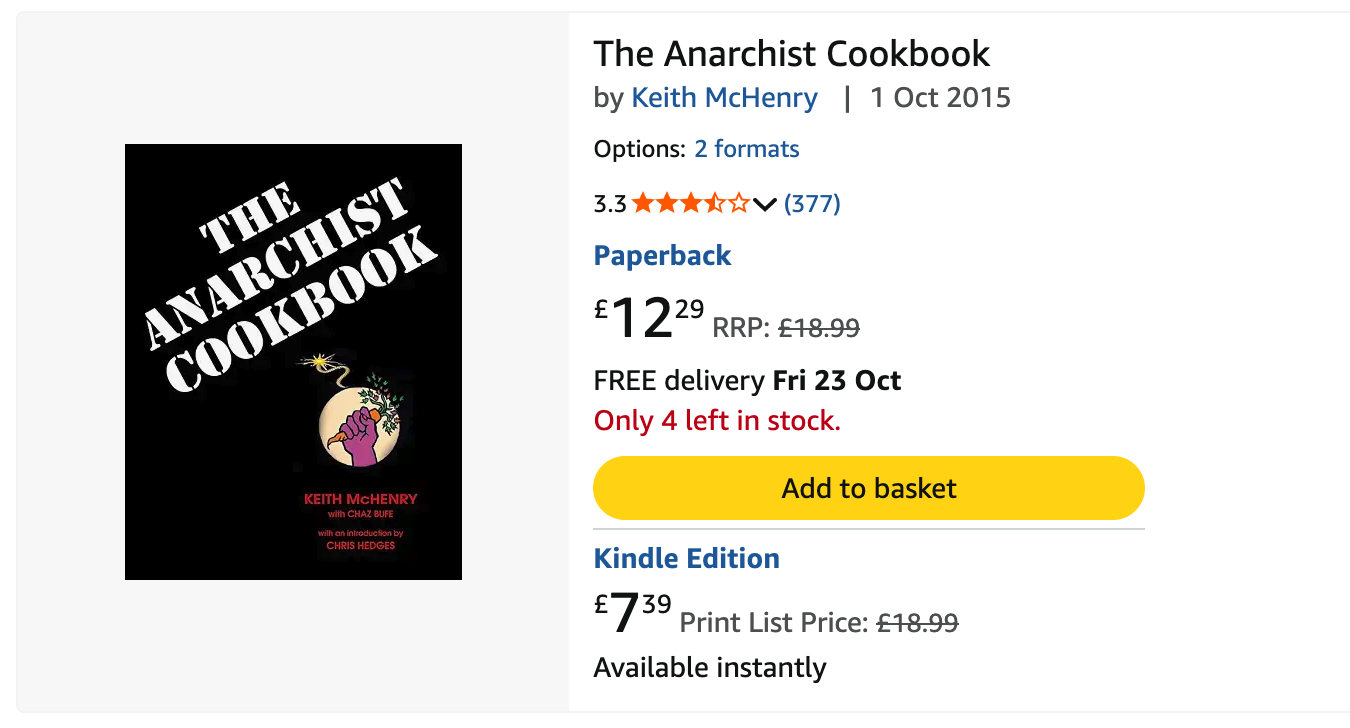
Amazon screenshot supplied on 19 October 2026. The listing identifies Keith McHenry’s 2015 edition; it is not assumed to be the same text as the documents involved in the cases below.
Commercial availability and criminal liability are different questions. The court record documents an Amazon purchase; the law turns on the material, knowledge and reasonable excuse—not a title alone.
United Kingdom · cases principally in England and Wales · Sources reviewed
Selected cases, not an exhaustive register. Outcomes are dated; they do not establish anyone’s current custody or licence status. Police accounts, reporting, judicial findings and our analysis are distinguished.
Is curiosity a reasonable excuse?
Neither “curiosity always works” nor “curiosity can never work” accurately states the law.
Appellate interpretation
The leading judgment expressly leaves the question open
R v G; R v J [2009] UKHL 13, paragraph 83
First, there was much discussion of a hypothetical situation where the defendant downloaded and stored information falling within section 58(1) “out of curiosity”. But the question as to whether he would have a reasonable excuse under section 58(3) is not one that can be answered in the abstract, without knowing exactly what the defendant did and the circumstances in which he did it. In an actual case where the issue arose, the specific facts of the case would inform the decision as to whether the defendant’s excuse for doing what he did either could or should be regarded as reasonable in the circumstances.
The Court of Appeal in Dunleavy reaffirmed that an excuse ordinarily goes to the jury unless it is plainly incapable of being reasonable. Believing one’s own explanation is reasonable does not settle the objective question. The court can consider the whole explanation and surrounding evidence, rather than the label “curiosity” in isolation.
Objectively reasonable—in the actual circumstances
These are complementary, not competing tests. Paragraph 79 supplies the objective standard: an explanation is not reasonable merely because the defendant thinks it is, or because the purpose was not terrorism. Paragraph 81 supplies the context: relevant factors can include age, background, associates, the circumstances of collection and the duration of possession. Objective does not mean context-free.
Paragraph 83 therefore refuses to decide a stripped-down hypothetical about curiosity. Our reading: the facts inform both whether an excuse is legally capable of being reasonable and whether it should actually be accepted. Paragraph 81 sets the boundary: unless no reasonable jury could regard the excuse as reasonable, the judge must leave the decision to the jury. This is neither automatic protection for curiosity nor its automatic exclusion.
Dunleavy invoked curiosity and self-education, but also admitted sharing material with people he understood to support extreme-right terrorist action. The court considered those purposes, his boasting and his anticipation of a race war. It upheld withdrawing reasonable excuse from the jury; an innocent purpose did not neutralise an impermissible additional purpose. His subsequent terrorism-preparation conviction also defeated the challenge. Leave to appeal was refused.
This is a wider section 58 authority, not another Cookbook prosecution. It illustrates why an explanation can fail on its facts—not a rule that every curious reader lacks a defence.
Section 58(3A)(b)(ii) expressly identifies academic research. Its text does not require university affiliation, peer review or ethics-board approval. That does not turn every private reading interest into academic research: the actual purpose remains a factual question. Nor must every reasonable excuse fit that category; the statutory examples are expressly non-exhaustive.
Introducing the amendment on 3 December 2018, Earl Howe told the Lords that journalism and academic research complemented the existing defence, rather than replacing it. Other equally reasonable explanations remained possible. This is legislative history, not a judicial guarantee that any particular reader’s explanation will succeed.
Legal possibility is not the same as practical reassurance
Kajsa E. Dinesson’s 2024 study combines case analysis with six interviews with experienced prosecutors and defence counsel. It finds that wider online behaviour and other “mindset material” can undermine curiosity explanations. Footnote 66 distinguishes a possible defence in principle from the author’s assessment that success is unlikely in practice. This small qualitative study is not a rule of law or a measured acquittal rate.
Dinesson also questions whether such evidence reliably distinguishes dangerous intent from curiosity, fantasy or vulnerability, especially for young and neurodivergent defendants. That is a substantive criticism of the law’s operation—not proof that all prosecutions are unjustified or that curiosity is legally forbidden.
The Amazon screenshot above and the historical court record below are distinct pieces of evidence. Their editions should not be conflated.
Court record and contemporaneous reporting
What the sources actually establish
In R v Bel, the Court of Appeal records that Oliver Bel ordered the book from Amazon in December 2018. Sky’s October 2017 report of Joshua Walker’s acquittal quotes his barrister pointing to availability through Amazon and mainstream retailers. These are dated records—not confirmation of current stock, every edition, or the legality of a particular purchase.
Our question is about intelligibility and consistency: how can an ordinary reader understand the legal risk when a commercial listing may look routine? Availability does not settle the statutory test. Nor does a prosecution over one document establish a blanket title-based ban.
The records identify different documents: Creagh’s was an online publication called Anarchist Cookbook of 2000; Howarth’s judgment identifies Anarchist’s Cookbook 4.14. We do not assume that every digital compilation, printed edition or similarly named text has identical contents.
Start with the offence and defence, not with assumptions about the reader’s politics.
Legislation
Collection, possession and internet access
Section 58(1) covers collecting or recording information likely to be useful in committing or preparing terrorism, possessing a document or record containing it, and viewing or otherwise accessing such a document through the internet. Subsection (1A) expressly includes internet collection and recording. The current maximum on indictment is 15 years’ imprisonment, a fine, or both; that is a ceiling, not a standard sentence.
The internet-access limb was added in 2019. The maximum rose from 10 to 15 years with effect from 12 April 2019. Historical cases must be read against the legislation and sentencing regime applicable to them.
Practical assistance and knowledge—not automatic liability
For possession, G and J requires control of the record, knowledge of possession and awareness of the information’s nature. The prosecution need not prove a terrorist purpose.
Couldn’t almost any information be useful to a terrorist?
G and J rejects that unlimited reading: an ordinary timetable or street atlas is not caught merely because a terrorist could use it. The information must itself provide practical assistance of the relevant kind. But usefulness need not be exclusive to terrorists: “dual use” is not a blanket exemption. Contents matter, not a book’s general category.
Section 58(3A)(a) includes lack of knowledge and lack of reason to believe that the material contained, or was likely to contain, the relevant information. Section 58(3A)(b)(i)–(ii) includes journalism and academic research. These examples are non-exhaustive; they are not separate subsections (3B) and (3C).
Read the word “prove” in section 58(3) alongside section 118(2) and (5). Once the defendant adduces sufficient evidence to raise the issue, the court or jury must treat the defence as satisfied unless the prosecution disproves it beyond reasonable doubt. This is an evidential burden, not an obligation on the defendant to prove innocence.
Section 57 concerns articles possessed in circumstances creating reasonable suspicion of a purpose connected with terrorism, with a defence that possession was not for that purpose. Section 58 focuses on the information’s nature, subject to reasonable excuse. The offences should not be collapsed into one test.
A section 58 conviction must not be silently upgraded into a finding that the person planned an attack.
Police account of conviction and sentence ·
Claudiu Stefan Cristea — 5 years 6 months
Counter Terrorism Policing reported on 24 June 2025 that a Leicester Crown Court jury convicted Cristea after a week-long trial and that he received five and a half years. A physical copy was found on a bookshelf following his February 2024 arrest.
Police describe an investigation into the far-right Einsatz14 chat group and suspected attack planning by individuals in it. They say Cristea shared racist and antisemitic views and disputed his claimed academic interest. The reported conviction is for section 58 possession, not a conviction for the suspected Leeds plot. A trial judgment has not been reviewed here.
Howarth pleaded guilty on 31 December 2021. On 15 February 2022 he received a special custodial sentence comprising 54 months in custody and a further 12 months on licence. On 24 November 2022 the Court of Appeal reduced the custodial term to 45 months, retaining the additional one-year licence period.
The court accepted aggravating factors but held that they justified the top of the relevant category range, not a term beyond it before the guilty-plea discount. A summary giving only the original sentence—or four years plus one—misses the appellate outcome.
John was convicted on the Cookbook count and acquitted of the six other counts. The judgment records far-right material on his hard drives, but also evidence that the charged items had not been accessed since their transfer in April 2019. Those distinctions matter.
On 19 January 2022 the Court of Appeal replaced the suspended sentence with a three-year special custodial sentence: two years in custody plus one year on licence. Its reasoning concerned the unlawfulness of the suspended sentence as structured, not simply a view that reading classic literature was too soft. The two-year custodial term was not, in itself, held unduly lenient in the unusual circumstances.
Bel was convicted in April 2021 and sentenced to two years in May. His academic-research or legitimate-intellectual-interest defence was rejected. The judgment describes extremist communications and contacts alongside the book; it does not treat a claimed academic interest as conclusive.
On 27 August 2021 the Court of Appeal granted leave but dismissed his sentence appeal. It concluded that immediate custody was inevitable on the facts and did not decide the broader legal question about suspending this type of sentence.
An acquittal is an acquittal. It should not be rewritten as suspicion, or as a reasoned judgment the jury never delivered.
Independent Reviewer’s case review ·
Daniel Creagh — acquitted on both counts
Creagh was acquitted at the Central Criminal Court on 16 March 2018 of section 58 possession and possession of counterfeit currency. The trial included disputes about knowing possession, knowledge of the document’s nature and its practical utility. Max Hill’s review neither challenged the verdicts nor purported to reveal the jury’s reasoning.
Sky reported that a Birmingham Crown Court jury acquitted Walker on 26 October 2017 after less than three hours. Police had found a 111-page printout in his Aberystwyth student accommodation after his return from Syria. He said he had printed it for a university role-playing group in 2015 and forgotten it.
That explanation and the verdict are reported facts. They do not establish a binding exemption for role-playing games, nor disclose exactly why the jury acquitted.
Short entries retain the limits of the source rather than inventing a fuller trial history.
Independent Reviewer’s secondary case summaries
Sneddon, Smith and the Ahmed brothers
Max Hill’s 2018 note records Warren Sneddon’s guilty plea; Roger Smith’s 2017 two-year sentence concurrent with explosives-offence sentences; and suspended sentences in 2014 for Mohammed Saeed Ahmed and Mohammed Naeem Ahmed involving several documents. Those trial records have not been separately examined here.
Our analysis: test the boundaries of the law without flattening different records into one story.
Research method
Wanting to understand the law is not a personal clearance
Our conclusion: studying why these prosecutions occur and establishing a defence for possessing a particular document are different questions. We cannot determine from “I became intrigued by the controversy” whether a court would accept an excuse. This research links to legislation, judgments and analysis, not the manuals. Anyone facing a real possession question or police enquiry should obtain case-specific advice from a criminal defence solicitor rather than rely on an AI-generated assurance.
Research method
A research record, not a prediction tool
A police announcement is not a transcript. A sentencing appeal may describe trial evidence without reconsidering the conviction. An acquittal does not disclose jurors’ reasoning. We do not infer attack planning from a possession conviction, estimate a reader’s chance of acquittal, or offer a checklist for manufacturing a reasonable excuse.
The supplied AI-generated drafts were treated as leads, not verified sources. The curiosity follow-up checked the revised statute, G and J, Dunleavy, the 2018 parliamentary debate and subsequent academic analysis. It did not establish a categorical ban on curiosity or a statutory institutional-affiliation requirement. Unchecked additional cases, claims about recipe reliability, and charge-frequency rankings have not been adopted. This is a targeted review, not an exhaustive case register or current retail stock audit. Corrections and additional primary records are welcome.
Source register
Sources are numbered in order of first citation; repeated citations keep their number. Source links open in a new tab. A source’s type matters: a campaign statement or personal account is not a judgment. The review date records this page’s source check, not a guarantee of completeness.
R v G; R v J [2009] UKHL 13House of Lords · UK Parliament · Published judgment · 2009-03-04 Checked 2026-10-19