Mental health in the UK
If you are crazy, that’s normal. If you are normal, that’s crazy.
The inverse Catch-22: mental health, disability support and institutional accountability. A satirical starting point, followed by evidence and questions—not a finding of benefit misuse.
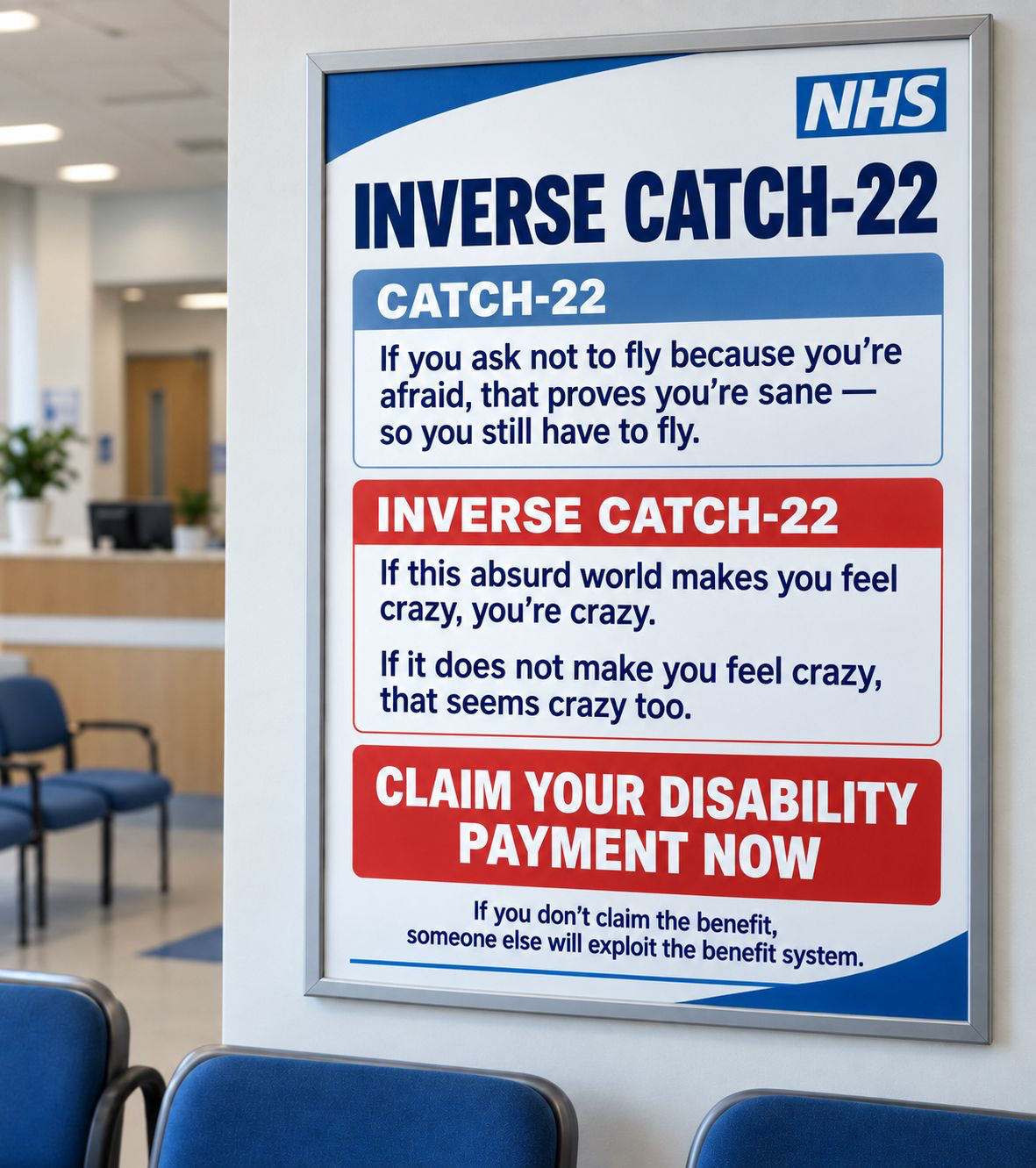
Read the artwork’s text (satire)
INVERSE CATCH-22. CATCH-22: If you ask not to fly because you’re afraid, that proves you’re sane—so you still have to fly. INVERSE CATCH-22: If this absurd world makes you feel crazy, you’re crazy. If it does not make you feel crazy, that seems crazy too. CLAIM YOUR DISABILITY PAYMENT NOW. If you don’t claim the benefit, someone else will exploit the benefit system.
User-supplied artwork, reproduced as supplied. The NHS mark does not indicate affiliation or endorsement; no rights in that mark are claimed.
The inverse Catch-22
The provocation is a reverse Catch-22: treating distress in an unsettling world as abnormal, while finding the absence of distress unsettling too. It is a metaphor about social expectations, not a diagnostic test.
The legal question is not who seems “normal”. It is whether decisions about support are justified by the relevant evidence and rules—and whether people can challenge a mistaken decision.
Complicity is a question to investigate, not a conclusion established by an incentive, a headcount or a conversation. Who benefits from the rules, who bears their costs, and what evidence would distinguish lawful help, administrative error and deliberate misuse?
Critical thinking from first principles
Starting from multiple independent anecdotes: people advising me how easy it is to get disability support, and that I should claim it.
I report multiple independent conversations in which people advised me that disability support was easy to obtain and encouraged me to claim it.
User-reported personal experience; not independently verified. Number of accounts: not supplied. Described as independent by the user; no information supplied to assess shared sources or social-network selection.
These anecdotes motivate the questions. They do not establish how easy eligibility is, whether the advice was accurate, how common misrepresentation is, or whether incentives explain the national figures.
Start with distinctions
- Separate the number of people with health-related needs, the number entitled to support, and the number unable to work.
- Determine what support is intended to achieve and what evidence demonstrates eligibility.
- Distinguish the existence of a financial incentive from evidence of its effect on behaviour.
- Measure resources used and outcomes achieved before judging efficiency or waste.
The scale—and what the numbers cannot tell us
A simplified account of scale and a starting point for investigating possible problems in eligibility, administration and incentives.
| Measure and figure | Period, scope and source |
|---|---|
| UK population69.5 million | Mid-2025UK, all ages; provisional[1] |
| Working-age populationApproximately 43.6 million | May-July 2026UK, ages 16-64; approximate population implied by rounded Labour Force Survey estimatesCalculation: 9,121,000 economically inactive / 0.209 inactivity rate; rounded to 0.1 million[2] |
| People in employment34.48 million | May-July 2026UK, ages 16 and over; Labour Force Survey estimate[2] |
| Disabled people16.7 million | 2024/25UK private-household survey population; long-term conditions limiting everyday activities. Not a count of benefit recipients or people unable to work.[3] |
| Public-sector workers6.21 million | June 2026UK headcount[4] |
| Disability support: Personal Independence Payment4.1 million | 31 July 2026England and Wales; claims with entitlement. Recipients may work. Not all UK disability support.[5] · [6] |
| Psychiatric-disorder category within disability support39% | July 2026Normal-rules Personal Independence Payment claims, England and Wales; not population prevalence, a work-capacity measure or a fraud estimate.[5] |
| NHS workers2.07 million | June 2026UK headcount; included in public-sector employment[4] |
| NHS share of public-sector workers33.3% | June 2026UK; calculated from rounded headcountsCalculation: 2.07 million / 6.21 million * 100[4] |
| Courts and tribunals service staffApproximately 19,000 | 2025/26 reportWhole HM Courts & Tribunals Service headcount; not benefit appeals alone or the complete assessment and appeals workforce[7] |
How to read these figures
- Groups overlap: do not add them or use them as mutually exclusive pie slices.
- Dates, geographical coverage and definitions differ.
- A minor headache or diagnosis alone does not establish Personal Independence Payment eligibility; qualifying functional difficulties matter.
- Null means unknown, not zero.
- The cited releases were checked on 17 October 2026. These are the dated figures selected in the author’s September note, not a claim that every series is the latest available release.
Law, entitlement and accountability
Eligibility is not a slogan
PIP concerns the effects of a long-term condition on everyday activities or mobility. A diagnosis or feeling distressed alone does not establish entitlement. PIP can be received while working; it is not an unemployment benefit. Scotland uses Adult Disability Payment for new claims. This page’s PIP statistics cover England and Wales, not the whole UK. [5] · [6] · [8]
Lawful support is not exploitation
Helping someone describe genuine difficulties and claim support they qualify for is different from encouraging false information. GOV.UK describes benefit fraud as intentionally claiming support to which someone is not entitled. These anecdotes do not establish that any particular person committed fraud. [9]
Decisions can be challenged
For PIP decisions in England and Wales, the usual route starts with mandatory reconsideration, followed by an appeal to the independent Social Security and Child Support Tribunal. Official guidance sets out deadlines and exceptions. Northern Ireland and decisions by Social Security Scotland have different routes. Independent Tribunal is not that statutory tribunal and cannot decide benefit entitlement. [10] · [11]
Exploiting the benefits system?
Could eligibility rules, financial incentives or shared claiming advice encourage some people to claim support without meeting the intended criteria?
Alternative explanations to test
- Advice helping genuinely eligible people access support
- Changes in underlying health and disability
- Greater recognition or diagnosis
- Changes in eligibility, administration or awareness
What would we need to know?
- Which benefit did each person mean, and what exactly did they advise?
- Were these accounts based on successful claims, hearsay or legitimate eligibility advice?
- Did advisers describe genuine functional limitations or encourage exaggeration?
- How representative are these conversations of people outside the same social networks?
- What evidence distinguishes the effect of incentives from changes in health, recognition or access?
- What are the current attributable workforce and full administrative cost of the complete process?
Still unknown
- Annual cost of the complete PIP administration and appeals chain: unknown.
- Workforce attributable to that complete chain: unknown.
- Share of claims caused by perverse incentives: unknown.
- Prevalence of misrepresentation in the reported anecdotes: unknown.
Unknown is not zero. The figures above do not supply these answers. Investigating institutional incentives should not become a presumption against people with mental-health conditions or disabilities.
Sources and provenance
The personal account and artwork were supplied by the author. Neither is independent evidence of benefit misuse. The figures link to the dated official releases below; the legal context links to official guidance. No private individuals are identified. Source links open in a new tab.
- [1] ONS: provisional UK population, mid-2025Official statistics or report · checked 2026-10-17
- [2] ONS: Employment in the UK, September 2026Official statistics or report · checked 2026-10-17
- [3] DWP: Family Resources Survey 2024/25, section 4Official statistics or report · checked 2026-10-17
- [4] ONS: UK public-sector employment, June 2026Official statistics or report · checked 2026-10-17
- [5] DWP: PIP statistics to July 2026, England & WalesOfficial statistics or report · checked 2026-10-17
- [6] GOV.UK: Personal Independence Payment eligibilityOfficial guidance · checked 2026-10-17
- [7] HMCTS accounts 2025/26, pp. 3, 20-21, 66Official statistics or report · checked 2026-10-17
- [8] GOV.UK: PIP eligibilityOfficial guidance · checked 2026-10-17
- [9] GOV.UK: Benefit fraudOfficial guidance · checked 2026-10-17
- [10] GOV.UK: Mandatory reconsiderationOfficial guidance · checked 2026-10-17
- [11] GOV.UK: Appeal a benefit decisionOfficial guidance · checked 2026-10-17
Back to the research library · Editorial standards
Contact
- GitHub issues — public; for corrections and sources
- Telegram — most current
- X / Twitter